Gaudi 2
- Memory
- 96 GB HBM2e
- Power
- 600 W class
- Platform
- Mezzanine or OAM servers, often eight accelerators per node, with the Gaudi networking built in
GPUsIntel · OAM, Gaudi 2 or Gaudi 3
Intel Gaudi 2 and Gaudi 3 are purpose-built AI accelerators, used in OAM or mezzanine platforms rather than as casual PCIe training cards. Tell us the exact generation you have, or the exact generation you need. We verify the hardware, match both sides, and run the deal through payment and delivery. If you're selling, you pick which offer to take.
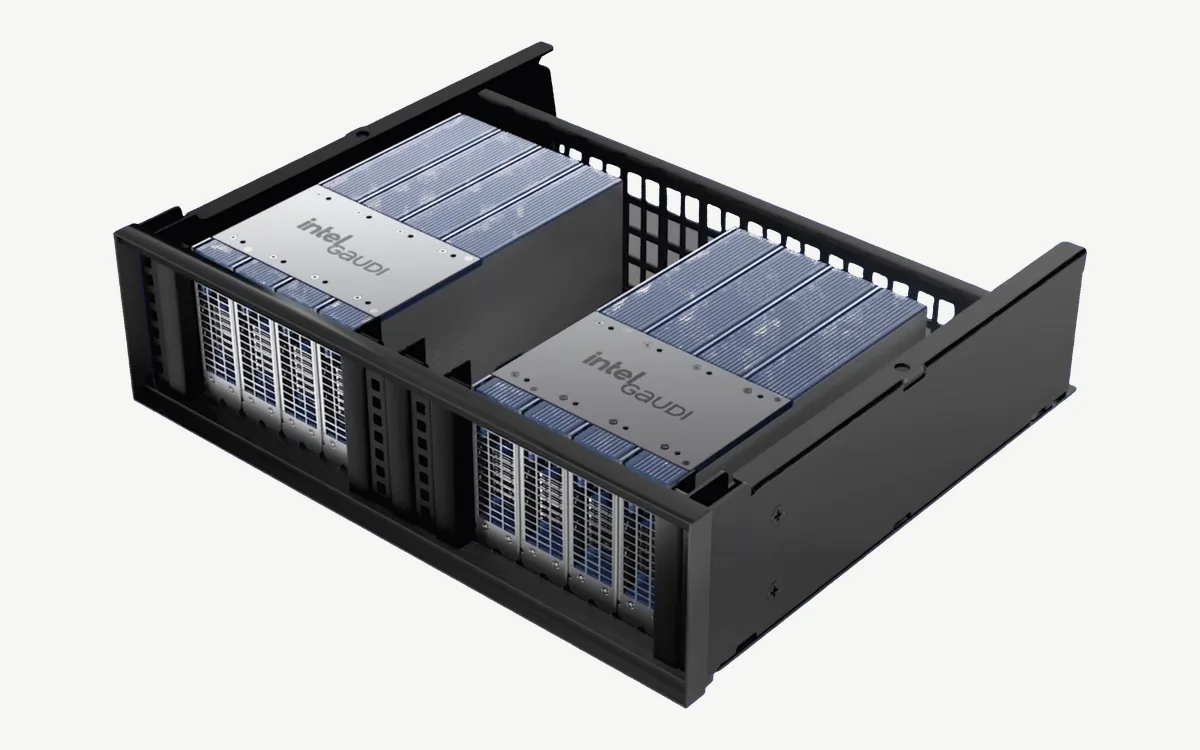
Gaudi is Intel's (formerly Habana) training and inference accelerator family, with on-board Ethernet-style scale-out rather than NVIDIA NVLink. The software stack is Intel's Gaudi software, not CUDA.
Published figures:
These usually move as complete 8-accelerator nodes, not as loose experiment cards. If you have NVIDIA or AMD systems, use those family pages.
The deal
Agreements first. We confirm the serials and condition, and qualify both sides.
Vetted buyers make offers. The seller chooses which offer to take.
Every destination is screened. Payment happens with delivery.
A family of Intel AI accelerators, with Gaudi 2 at 96 GB and Gaudi 3 at 128 GB, used in dedicated OAM or mezzanine servers and Intel's software stack.
Gaudi 3 has 128 GB of HBM2e at 3.7 TB/s, and a higher power envelope (900 W air or 1,200 W liquid per OAM). Gaudi 2 has 96 GB and a 600 W-class card TDP.
No. It runs on Intel's Gaudi software. Tell us that on both sides of a match so the stack is not a surprise.
Official material puts OAM TDP at 900 W with air cooling or 1,200 W with liquid cooling, per accelerator.
Tell us Gaudi 2 or Gaudi 3, air or liquid, how many, the condition, and where they sit. We verify the hardware, match your Have with a Need, and handle the deal. You pick which offer to take.
Tell us the generation, how many, and what power and cooling you have ready. We match your Need with a Have and run the deal through payment and delivery. We don't publish prices.
Every buyer and every seller passes a KYC identity and company check, and a Replenysh person reviews every buyer before they see a deal. Every buyer and destination is screened against export-control and sanctions lists before the hardware moves.
Tell us what you have, or what you need. We verify, match, and handle the deal.